


Error message title

Error message title

Searching great energy plans for you
Creating intentional career pathways for women, enhancing job retention, and improving career elevation
14 October 2026 - Women in Renewables Conference 2026. Speech by Laura Caspari
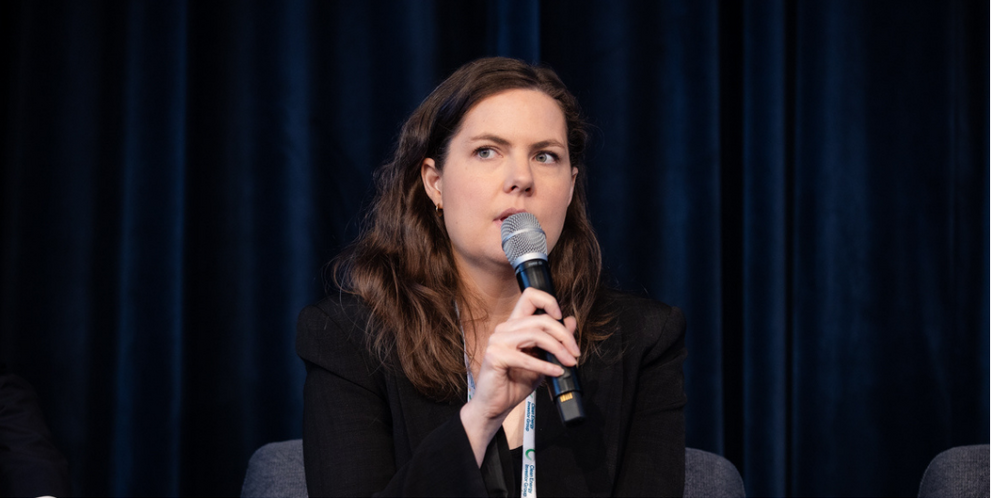
Good morning and thank you for having me. I’m going to start this morning with some personal reflections and then get into the opportunity.
Yesterday afternoon I was cutting through Hyde Park, right across the street. At the north side of Hyde Park I walked past St. James Church, which I believe is the oldest church in Sydney. My great-great-great grandparents, Margaret and William, were married there in 1843. Margaret was very young, recently arrived alone from Ireland. William was decades older and had arrived 15 years prior as a convict in chains.
As I walked, I asked myself the question, why had this young girl married someone like that? There could be many answers, but I believe the most likely one was probably protection and security. Margaret would have been very economically insecure. She would have had few rights and few prospects. She lacked the protection I have today of education, training, career, leading to stable income. Margaret probably had to marry an old convict to survive.
We all know how far women have come since that marriage in 1843 in terms of our progress towards our economic security and our rights, which Margaret suffered the lack of.
However, if women had real economic equality, we would not be holding this conference today.
I submit that the energy transition provides one of Australia’s greatest opportunities to provide that economic security for women, through good jobs, training, and career development pathways. We cannot deliver the scale of change Australia needs while drawing from only part of the available talent pool. Nor would that be equitable.
I want to start with a simple proposition: the energy transition is not only an infrastructure challenge. It is a workforce and leadership challenge.
Australia is building renewable generation, storage, transmission and digital energy systems at an unprecedented pace. But physical infrastructure is only half the equation. The human infrastructure—who enters this industry, who gains critical experience, and who leads—will determine whether we can deliver.
At ENGIE, gender equity is not a side conversation to the energy transition. It is a business, capability and execution priority. I will do my best to make the case for why gender equity should be a priority for all of your businesses too, as well as share some examples of what we have done at ENGIE as suggestions for you to consider drawing from.
The workforce challenge is significant. Recent modelling suggests Australia may need almost three times the current clean energy workforce within the next five years, while women remain underrepresented. Particularly in many technical and operational roles. For CEOs and boards, that is not simply a diversity gap. It is a material delivery risk. If we cannot build the workforce, we cannot build the projects, operate the assets or sustain the pace of investment the transition requires. Attracting, retaining and advancing more women is therefore essential to workforce capacity and industry performance. The energy transition needs every capable engineer, electrician, technician, project manager, operator and leader we can find.
Recruitment matters, but it is only the beginning. The real test is whether women can enter, thrive, progress and stay—and whether they can see a credible path to senior operational and executive leadership, for those who want to.
The barriers are real: smaller talent pools in some disciplines, limited entry pathways and role models, remote locations, roster patterns, training constraints and site infrastructure designed around a largely male workforce.
These are not reasons to lower ambition. They are reasons to manage workforce capability with the same discipline we apply to capital, safety and project delivery: clear pathways, deliberate investment, measurable outcomes and executive accountability. On accountability, put it in their KPIs. I’ll come back to that.
Many renewable energy careers begin in field and operational environments. If we want more women in those roles, leaders must examine the experience we are creating—not only the numbers we recruit.
That means getting the fundamentals right:
- Appropriate facilities on site
- PPE designed specifically for women- don’t make safety equipment a safety risk itself by having it be ill fitting, increasing the risk of snags and trips. Don’t make her do a special order to have it available. Keep it in stock. And don’t assume the only woman on site wants a pink hard hat foisted on her (which yes, has happened to me).
- Safe and inclusive work environments. Sometimes people ask, why didn’t she just speak up? The answer is often because she didn’t feel personally safe to do so.
- Flexible ways of working where operationally possible
- Leaders who actively promote inclusion. It is on you; what the boss prioritises, the team follows.
- Cultures where women feel they belong from day one
None of these actions are revolutionary. Together, they signal that women are not guests or exceptions in this industry, but equal participants in its future.
For regional communities, these details matter. A role at a wind farm, solar farm or battery site may require long travel, non-standard hours or extended time away from home. Practical choices around rosters, transport, facilities and flexibility can determine whether local women can take up—and remain in—those opportunities.
One initiative I'm particularly proud of is ENGIE's involvement in the Powering Her Pathway program.
Powering Her Pathway is a partnership between ENGIE, Tradeswomen Australia, TAFE Gippsland and RMIT.
The program was established to address the barriers women face entering clean energy trades and technical careers.
Importantly, it doesn't just focus on training.
It looks at the whole ecosystem.
- Awareness of career opportunities
- Education and skills development
- Employer readiness
- Workplace culture, and
- Employment pathways
The program aims to create tailored pathways into clean energy careers for women while building a broader blueprint for a more inclusive workforce.
Its Gippsland focus is important. Regions hosting the energy transition should also share in its careers, skills and economic benefits. By connecting local training providers, industry and community partners, programs like this can help women build careers close to home, while strengthening the workforce available to regional projects. Plus, by demonstrating the jobs available in our industry to locals, we strengthen our social license. Win win.
Its value is practical: tailored pathways for women, stronger local capability and a blueprint employers can scale. If we want different outcomes, we need intentional interventions. Hope is not a workforce strategy. Action is.
Entry is only half the challenge. The more difficult issue is the missing middle: talented women enter technical roles, but too few gain the experiences that lead to senior operational and executive positions.
Leaders should measure access to opportunity, not only representation:
- Who receives stretch assignments
- Who leads major projects and commissioning
- Who gets operational and commercial exposure
- Where women leave—and why
- Who is identified in succession plans. At ENGIE we have a deliberate focus on succession planning to ensure we are developing and making ready the future leaders of our business. It insulates our business from the risk of exits, and helps retain key talents who feel they have an intentional development plan. We have benchmarks to ensure female representation in succession plans and currently 50% of our Global Key Positions have women successors – its starts from the top.
These are leading indicators of future leadership. Some of our future CEOs, project directors and operational leaders are already on sites, in control rooms and in engineering teams. Our responsibility is to ensure talent—not invisible barriers—determines what comes next.
Sponsorship is one of the most powerful tools leaders have. Mentors provide advice; sponsors create access—to stretch assignments, decision-makers, promotion conversations and roles that accelerate careers.
One conversation, introduction or opportunity can change a career trajectory. Every leader in this room can do that. I would doubt there are any people in positions of power today who have not benefited from sponsorship, whether they knew it or not. So use your power intentionally.
We also need to change how we talk about leadership development for women. Confidence matters, but confidence alone will not build Australia’s future energy system.
Technical, operational, commercial and project-delivery capability will. Women need access to the assignments that build credibility: running projects, leading commissioning, managing assets, developing commercial strategy and overseeing operations.
That is how future executives are built. Leadership pipelines are not created in the final promotion round; they are created years earlier through deliberate access to consequential work.
At ENGIE, we are proud of our progress and clear-eyed about the work still ahead. Our approach combines policy, capability and accountability. Such as:
- A dedicated Gender Equity Strategy
- Gender pay equity reviews and monitoring
- Women in Leadership development programs
- Expanded parental leave benefits
- Flexible work arrangements
- Family and domestic violence leave enhancements
- Development pathways for emerging leaders
- Gender targets are embedded into leadership accountability. Since we brought in these KPIs and put a focus on them, our hiring of females has increased by 15%. I would also note that my executive leadership team is 50% female and my renewables leadership team is 50% female. Operational and technical roles are my gap. I know this because we identify, track, and work on actively on it.
Parental leave is particularly important. Careers should not stall when people start or grow a family, and caring responsibilities should not sit with women alone. Stronger support for primary and secondary carers helps retain talent, opens leadership pathways and contributes to greater equality at home and at work. It also levels the playing field when men take the same length of parental leave as women.
The CEO-level question is not whether these initiatives exist. It is whether they are shifting outcomes: retention, pay equity, access to critical experience, succession representation and progression into leadership.
Equity is the right thing to do. It is also fundamental to building a stronger, more capable and resilient business.
Diverse teams bring broader perspectives to complex decisions, challenge familiar assumptions and better reflect the customers and communities we serve. That supports stronger judgement, innovation and trust.
In a sector competing for scarce capability, it also strengthens our ability to attract and retain talent. This is not peripheral to business performance; it is part of how we manage execution risk and create long-term value.
There is also a broader community dividend. When regional projects create accessible pathways for local women—through training, apprenticeships, operational roles and supplier opportunities—the value of the transition is more visible and more widely shared. That builds local capability, supports regional economies and strengthens trust in the projects communities are being asked to host.
Closing
I will leave you with one final thought. The energy transition is not only an opportunity to transform how Australia produces and uses energy. It is an opportunity to transform who builds it, who leads it and who benefits from it.
If we create intentional pathways, remove structural barriers and give women access to the technical, commercial and operational experiences that shape leaders, we will build a more equitable industry—and a stronger one. The Margarets of the world will have all the economic security they need to feel safe and to thrive.
And we will leave a stronger legacy in the regions at the centre of this transition: deeper local skills, more inclusive employment and communities that can see a lasting benefit from the projects around them. And communities that see women as role models in technical or leadership roles, which can shift how they think about the role of women and traditional gender assumptions in positive ways.
As a CEO, I see this as a leadership responsibility. Talent is widely distributed; opportunity is not. Our job is to close that gap deliberately, measure whether our actions are working and hold ourselves accountable for the workforce we build. Because the success of the energy transition will depend not only on the assets we deliver, but on the capability and leadership we build along the way. Thank you.