

Error message title

Error message title

Searching great energy plans for you
Australia’s energy transition faces a question we haven’t answered honestly enough: who pays?
Everyone agrees on the destination – a cleaner, more reliable, lower‑emissions energy system.
The debate that’s now unavoidable is about the journey — and specifically, who carries the cost of building it?
Everyone agrees on the destination – a cleaner, more reliable, lower‑emissions energy system.
The debate that’s now unavoidable is about the journey — and specifically, who carries the cost of building it?
Right now, the default answer increasingly appears to be: energy customers do.
Households and businesses are being asked to fund enormous new infrastructure through their power bills, often under a neat‑sounding “user pays” logic that struggles when applied to projects of national scale and complexity.
Take EnergyConnect. What began as a critical, nation‑building interconnector is now facing a $1.1 billion cost blowout. Recent media coverage has made clear that a decision now looms about how that overrun will be funded — and, in particular, whether it will ultimately fall to customers through higher network charges.
This isn’t a criticism of our ambition - it’s a reminder that mega‑infrastructure is inflation‑exposed, long‑dated and inherently uncertain. But it also highlights an unresolved tension at the heart of the energy transition: when costs escalate on projects that deliver broad, system‑wide benefits, who should reasonably carry that risk?
Energy isn’t unique in this.
When the NBN was rolled out, there was an early assumption that costs could largely be recovered from end users over time. That approach didn’t last. Governments ultimately recognised that loading essential, economy‑wide infrastructure onto consumers would risk affordability, slow adoption and create political and economic drag. Public funding stepped in — not because markets had failed, but because the public benefit exceeded what individuals could reasonably fund upfront.
Which leads to a simple but important question - When has massive, nation‑building infrastructure ever been delivered purely on a “user pays” basis?
Roads? Rail? Ports? Water? Telecommunications?
The answer is clear: it doesn’t happen — at least not without government sharing risk, smoothing costs or underwriting outcomes.
What makes this question especially urgent now is our inflationary context.
This debate isn’t new — but our current economic circumstances are. Australia’s CPI is running at 3.8%, above the Reserve Bank’s target band, and the RBA has made clear that inflation is not expected to sustainably return to the 2–3% range until around 2028. That is a long time for households and businesses to absorb additional, avoidable price pressure.
In this environment, decisions about how we fund the energy transition are no longer abstract. Energy costs flow through the entire economy — into food, housing, transport and services. If large‑scale transition costs are pushed directly onto electricity bills, they don’t just lift power prices; they risk entrenching inflation at precisely the moment policymakers are trying to bring it back under control.
We already acknowledge this reality in practice. Energy bill relief rebates, battery schemes and other interventions exist because energy prices matter disproportionately to cost‑of‑living outcomes and inflation. The opportunity now may be to ask whether a less piecemeal, more coordinated approach could deliver better outcomes than a series of reactive fixes.
So why do I — and ENGIE in Australia — care so deeply about this?
First, because we see consumers up close.
As an energy retailer, we see the real cost‑of‑living pressures facing households and small businesses every day. When infrastructure costs are socialised through bills, the burden doesn’t fall evenly. Those least able to absorb price increases often carry the greatest weight. An energy transition that unintentionally deepens inequity risks losing the social licence it depends on.
Second, because we have a track record of moving early and decisively.
ENGIE has already made difficult calls in Australia — including exiting coal at Hazelwood — because we believe the energy transition is both necessary and inevitable. Moving early brings benefits, but it also brings risk. We’ve lived that reality.
Third, because investment certainty matters.
The question for investors isn’t just whether to build — it’s when, and under what rules. Do we invest now and take market risk, only to see future subsidies or interventions introduced outside the market for new assets? If so, what does that mean for the returns of those who moved first? Uncertainty around future policy settings can slow capital at precisely the moment Australia needs it to accelerate.
At ENGIE, we want to invest more in Australia. We believe deeply in this market and its potential to deliver abundant, reliable and increasingly green energy. Private capital can — and should — do much of the heavy lifting in the transition.
But every transition has a messy middle.
Coal will continue to exit before firmed renewables are fully scaled. Transmission must be built ahead of generation. Storage, firming and flexibility take time — and capital — to mature. These are not just commercial challenges; they are system‑wide ones.
So perhaps the most important task for policymakers right now is not to prescribe answers, but to wrestle with the right questions:
- How should the costs of nationally significant energy infrastructure be shared over time?
- How do we protect consumers — especially vulnerable ones — without dulling the signals needed to attract investment?
- How do we ensure early movers aren’t penalised as policy evolves?
- And how do we move from short‑term relief to long‑term affordability?
The question isn’t whether Australia can afford to help bridge the energy transition. The real question is whether we can afford not to.
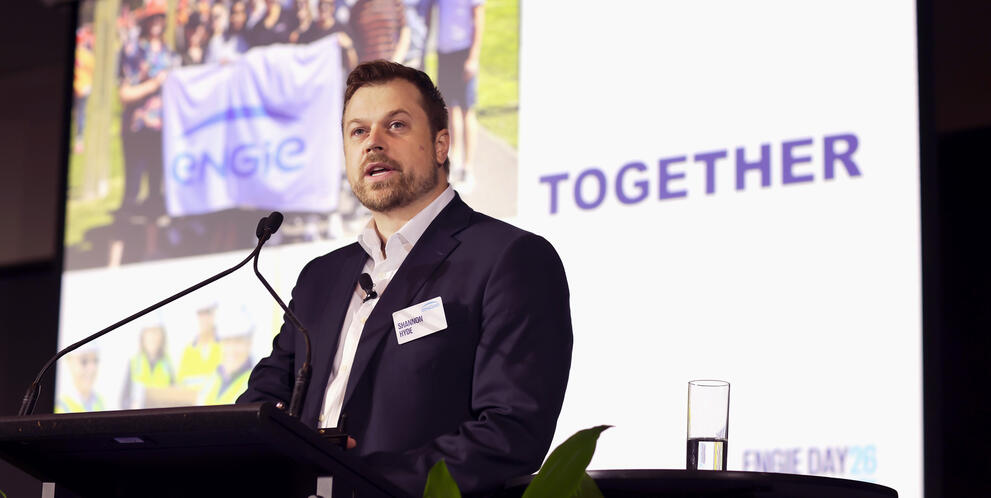
Shannon Hyde,
CEO – ENGIE ANZ